The patent industry is moving from winning by quantity to improving by quality.

In 2017, China’s patent industry rose in quantity and quality, patent creation made steady progress, and China patents began to enter a new era of development.
From quantity winning to quality improving.

Panorama of FAST project. Xinhua News Agency reporter Liu Xushe

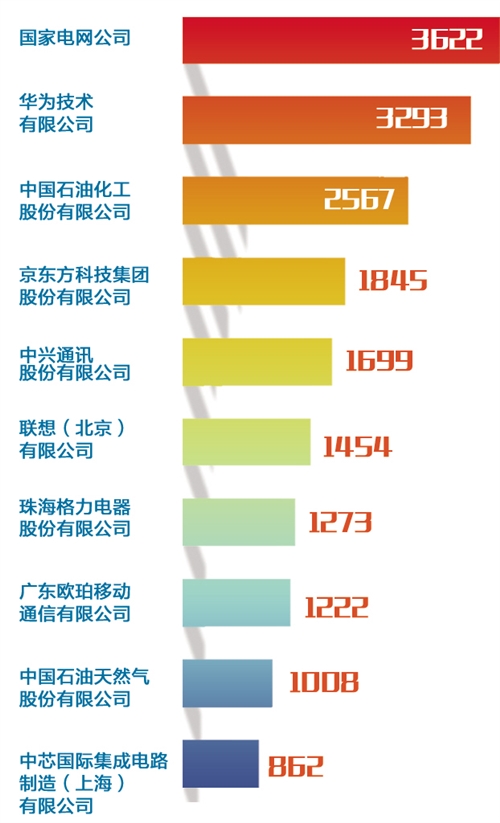
In 2017, the top ten enterprises (excluding Hong Kong, Macao and Taiwan) granted invention patents in China: pieces

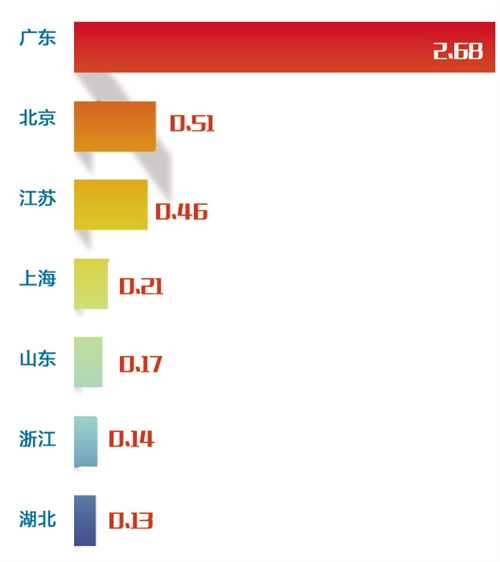
In 2017, provinces (autonomous regions and municipalities) with more than 1,000 PCT international patent applications: 10,000.

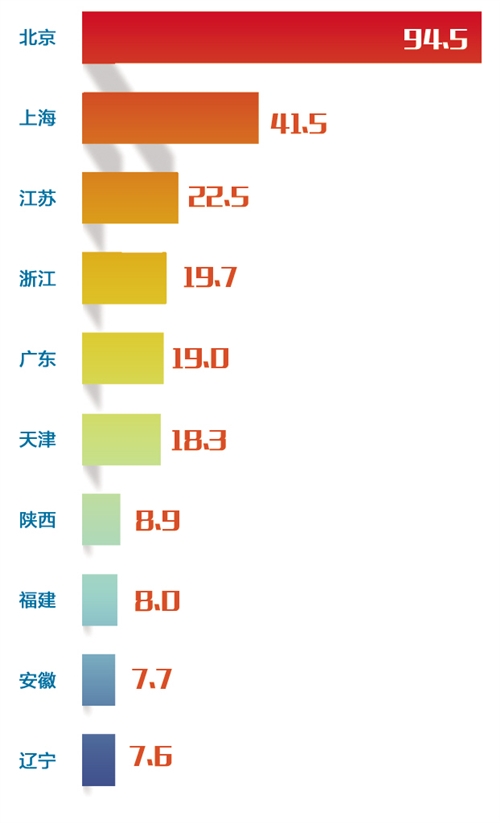
In 2017, the top ten provinces (autonomous regions and municipalities) with invention patents per 10,000 population in China: pieces

Although Chinese enterprises are growing rapidly in the fields of mobile communication, electronic information technology and chemical industry, the number of foreign invention patents in China is higher than that in China in five fields, such as optics, medical technology, engine, audio-visual technology and transportation.

Judging from the number of invention patents that have been maintained for more than 10 years, the number in China is still less than that in foreign countries in 29 technical fields, and it is still necessary to continue to cultivate high-value core patents in the above fields.

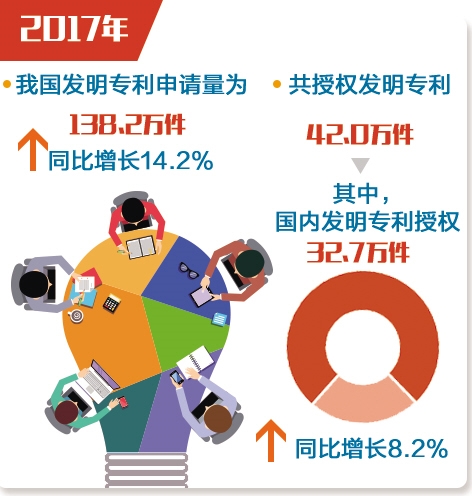
Recently, China National Intellectual Property Administration released the information about China’s invention patents and the ranking of enterprises in 2017. The data shows that in 2017, the number of invention patent applications in China was 1.382 million, a year-on-year increase of 14.2%. A total of 420,000 invention patents were authorized, including 327,000 domestic invention patents, an increase of 8.2%. The surging momentum of generate’s patent industry, which is rising in quantity and quality, has made the pace from a big intellectual property country to a strong intellectual property country more solid and powerful.

Innovation ability is increasing day by day.

Enterprises have performed very well in the application and authorization of invention patents. "In 2017, the proportion of domestic invention patent applications and ownership in China reached 63.3% and 66.4% respectively, up by 1.6 and 0.9 percentage points from 2016." Bi Nan, Director of China National Intellectual Property Administration Planning and Development Department, said.

In 2017, among the top ten enterprises in China (excluding Hong Kong, Macao and Taiwan) in the number of invention patents granted, there are both "frequent customers" like Huawei, Sinopec, ZTE and BOE, and also new industries like Opal. There are senior strength groups such as Gree Electric, Lenovo and State Grid, and rising stars such as SMIC.

"The ranking of the number of enterprise invention patents granted this time shows the latest progress of China’s innovation-driven development strategy from one aspect, and it is characterized by diversity in one word." Liu Haibo, a researcher at the Institute of Science and Technology Strategy Consulting of China Academy of Sciences, told the Economic Daily reporter that, just as biodiversity is a symbol of the ecosystem, the diversity of the top ten enterprises in the list indicates that China’s innovation ecosystem is becoming more and more active, more resilient and has greater potential for sustainable innovation.

Su Ping, dean of the Intellectual Property College of Chongqing University of Technology, believes that the list directly reflects that the innovation ability of some enterprises in China has been continuously strengthened, and the status of enterprises as the main body of intellectual property creation and application has become increasingly stable. Counting the ranking of invention patents granted by domestic enterprises, Huawei, ZTE, BOE, Opal and Lenovo are all technology-based enterprises focusing on communication and electronic information technology, occupying five seats in the top ten. At the same time, ZTE, BOE and Huawei are among the 100 innovative enterprise clusters in the "2017 Global Innovation Index" published by the World Intellectual Property Organization, which shows that Chinese enterprises are gradually occupying a dominant position in these fields.

In addition, as a representative of R&D-intensive enterprises, SMIC International Integrated Circuit Manufacturing (Shanghai) Co., Ltd. also ranks among the top ten with 862 invention patents. "This shows that enterprises can catch up as long as they attach importance to innovation and increase patent protection and application." Su Ping said.

Compared with the ranking of invention patents granted by domestic enterprises (excluding Hong Kong, Macao and Taiwan) in 2016, it is not difficult to find that the top five enterprises in the past two years are basically the same. In this regard, Su Ping explained that patent creation, application and authorization are closely related to the law of innovation and development. On the one hand, under the influence of the new round of global innovation competition leading paradigm, the above-mentioned enterprises put intellectual property strategy at the core of enterprise development and invested a lot of R&D power to carry out innovation, so the number of authorizations is naturally large; On the other hand, enterprises that have tasted the sweetness in the patent market pay special attention to patent layout, take patent protection measures for their innovative achievements, and add value to enterprises through patent operation, forming a virtuous circle from innovation to patent to benefit.

Pay more attention to quality improvement

Different from the past, this time China National Intellectual Property Administration only published the ranking of domestic enterprises’ invention patents granted, but did not publish the ranking of domestic enterprises’ invention patent applications. In this regard, China National Intellectual Property Administration spokesperson Hu Wenhui explained that the purpose of adjusting the disclosure content of patent statistical data is to further improve the quality of patents and give full play to the innovation-oriented role of patent statistical indicators.

"This really sends us a signal that China will pay more attention to the quality of patent applications." Su Ping said that judging from the proportion of China’s patents granted in the world, China’s patents have won in number and become a veritable intellectual property power, and the next step is to improve the quality. It is reported that by the end of 2017, the number of invention patents in China (excluding Hong Kong, Macao and Taiwan) totaled 1.356 million, and the number of invention patents per 10,000 population reached 9.8.

"The level of patent creation has progressed steadily, thanks to the fact that in recent years, China has paid more attention to improving the quality and efficiency of intellectual property while paying attention to improving the quantity of intellectual property." Bi Nan said that since the 18th National Congress of the Communist Party of China, China National Intellectual Property Administration has put forward the concept of "quality wins, quantity distribution" and started to implement the patent quality improvement project. Focus on the whole chain of patent work, formulate a series of targeted measures around important links such as patent application, agency, examination, protection and application, and improve the quality of patents with multiple measures. Improve the efficiency of patent application, create a good patent protection environment, and promote high-quality creation and high-value patent implementation.

"Eye of the Sky" sounding, "Dragon" going into the sea, "Kunlong" flying successfully for the first time, and high-speed rail running out of "China speed" … Driven by a series of measures, China’s patent creation has formed a good situation in which the quantity and quality have risen together. Among the 35 technical fields classified by the World Intellectual Property Organization, in 2017, the number of domestic invention patents was higher than that of foreign invention patents in China by 30. "But we should also be soberly aware that there are not many foreign enterprises applying for invention patents in China, and there is still a long way to go from quantity layout to quality victory." Su Ping said.

"The content of patent statistics released this time has changed significantly, which really conveys the judgment of the government authorities on the current patent situation and the signal of the next policy adjustment." Liu Haibo believes that at present, creating high-quality core patents should be listed as the top priority of China’s patent work, but the transformation process from winning by quantity to improving quality is long and even more painful.

Some areas need to be strengthened

Although Chinese enterprises have grown rapidly in the fields of mobile communication, electronic information technology and chemical industry, we should also see that there is still a gap between the patent layout in some fields and that in foreign countries. "At present, in the five fields of optics, medical technology, engine, audio-visual technology and transportation, the number of foreign invention patents in China is higher than that in China." Bi Wei said that from the perspective of maintaining the number of invention patents for more than 10 years, the number in China is still less than that in foreign countries in 29 technical fields, and it is still necessary to continue to vigorously cultivate high-value core patents in the above fields.

"If mobile communication, electronic information and other industries invest heavily in research and development, they can present technological achievements in a short period of time. In order to make a breakthrough in high-end manufacturing, we must make long-term breakthroughs in core technologies such as bearings, gears, reducers and transmission devices. " According to Tang Heng, director of Jiangsu Intellectual Property Research Center, the reason why China lacks patent layout in high-end equipment such as optics, transportation and engines is because of the lack of innovation accumulation in these fields.

Patents are strategic weapons for enterprises to control the market and participate in competition, while vigorously developing high-end equipment is the only way to promote the transformation and upgrading of traditional manufacturing industries. Therefore, patent layout in the field of high-end equipment plays a vital role in revitalizing China’s real economy. "Just like strategic weapons need long-term pre-research, high-input research and development, high-intensity testing and high-quality production, cultivating high-quality core patents in the fields of engines and transportation requires creative courage to climb and persistent innovation." Liu Haibo said.

A very important reason for the short patent maintenance time is that the quality of the patent itself is not high, the application value is low, and the demand for technology market is shrinking. "From the perspective of maintaining the number of invention patents for more than 10 years, we do have a certain gap with foreign countries, which also shows that the quality of patents in these technical fields in China is not high enough." Su Ping suggested that in the future, Chinese enterprises should increase investment in R&D, plan the patent layout in advance according to the development direction of technology, and provide good technology from the source of innovation. At the same time, we should further strengthen the ability of patent application and improve the level of patent industrialization.

"In the process of patent examination, the state should moderately shift the focus to the patent maintenance time. Enterprises should also pay more attention to the second or even multiple research and development of patents, aim at the forefront of the industry, constantly integrate business needs with patent creation, and give them stronger market functions, so as to effectively extend the patent maintenance time. " Tang Heng said. (Reporter Li Peng Da)

Experts from developing countries discuss the development of China.

  Xinhua News Agency, Beijing, August 20th  Topic: Experts from developing countries discuss the development of China.

  Xinhua news agency reporter

  China’s development achievements in the new era have attracted worldwide attention, attracting more and more overseas people to explore the ideological source and scientific practice behind it. Recently, the National High-end Think Tank of Xinhua News Agency released "The Development Code for a Modern Power — — The characteristics of the times and practical value of the supreme leader’s economic thought and the "second combination" to change China — — The English and French versions of the two think tank reports "Theoretical Innovation and Practice of Building a Modern Civilization of the Chinese Nation" have attracted the attention and heated discussion of the industry in developing countries.

  Many experts and scholars from developing countries believe that the supreme leader’s economic thought has distinctive China characteristics, which provides a powerful ideological guide for Chinese modernization and provides China wisdom and China’s plan for promoting world economic development.

  Charles Onunaiju, director of Nigerian China Research Center, said that China has put people’s interests, needs and happiness at the core of development, helped hundreds of millions of people get rid of poverty, and its achievements have attracted worldwide attention. He said that the biggest challenge on the African continent is poverty, so we should learn from China and take targeted measures to improve people’s living conditions and achieve sustainable development. Onunaiju emphasized that Chinese-style modernization promotes a better combination of the government and the effective market, and gives full play to the positive role of the government in strategic planning and policy formulation, while respecting market rules and releasing the vitality of market players. This model has also achieved a series of concrete results in China-Africa cooperation, providing valuable enlightenment for the economic development of African countries.

  On June 5, 2008, maintenance personnel planted saplings at the place where the Xinjiang Institute of Ecology and Geography of the Chinese Academy of Sciences cooperated with the Nigerian African Desertification Control Initiative. (Photo by Xinhua News Agency reporter Guo Jun)

  Dylan pascua, editor-in-chief of Brazil’s Financial Information Group, believes that China adheres to the "people-oriented" concept and allows people to participate in the development process, providing a model for the economic and social development of developing countries.

  Austin Thomas, editor of Sierra Leone’s Awok newspaper, studied in China and was deeply impressed by the achievements made by China. Thomas said that African countries need to learn from China’s wisdom, constantly meet the needs of people’s life and development, and focus on long-term interests to promote sustainable development.

  Tidiane Gadio, former Senegalese foreign minister and president of the Pan-African Institute for Strategic Studies, said that the Supreme Leader proposed to build a community of human destiny, which strongly promoted cooperation among developing countries and promoted common prosperity. Gadio emphasized that under the current international environment, China has played an important role in promoting the recovery and growth of the world economy. In particular, China-Africa cooperation has been further strengthened and new achievements have been made, which fully embodies the development concept of inclusiveness, mutual benefit and win-win.

  Costantino Berhutes, a professor at Addis Ababa University, said that China adheres to the people-oriented principle and development priority, promotes the construction of an open world economy, and helps developing countries better integrate into global industrial chains and value chains. By jointly building the Belt and Road Initiative and proposing global development initiatives, China has provided new ways to solve global development problems and promoted cooperation among countries to meet common challenges facing mankind.

  This is the interior of the headquarters building of the African Center for Disease Control and Prevention, which was filmed in Addis Ababa, Ethiopia, on January 8. On January 11th, China officially completed the project of assisting the African Center for Disease Control and Prevention (Phase I). (Photo by Xinhua News Agency reporter Dong Jianghui)

  Elliot Doyle, president of Brazil Telecom, said that China seeks friendly cooperation with other countries, helps Asian, African and Latin American countries achieve development based on its own experience, and continues to pursue peace, progress and prosperity, setting a very positive example for other developing countries in many fields. Doyle said that developing countries such as Brazil should make joint efforts with China to continuously promote the development of multilateralism.

  On July 12th, tourists took a group photo with BYD pure electric bus in kamps, Sao Paulo, Brazil. (Photo by Xinhua News Agency reporter Wang Tiancong)

  Melere Mulindabigwe, CEO of Time News Network, a mainstream Rwandan media, said that China regards Africa as an equal partner, and China-Africa cooperation has become a model for cooperation among developing countries. China has continuously promoted infrastructure construction and economic and trade cooperation projects in Africa, so that African people can gain development opportunities from cooperation.

  Cavens Adehir, a Kenyan expert on international issues, believes that China advocates that all countries help each other in the same boat, not only pursuing justice in the process of development, but also sharing the fruits of development with other countries. The China concept resonates all over the world, reflecting the common aspiration of developing countries.

The premiere of the film Mao Zedong in Caixi will be released nationwide on May 8.


1905 movie network news A few days ago, the film held the national premiere ceremony of Mao Zedong in Caixi Town, Shanghang County, Longyan City, Fujian Province. Party and government leaders from Fujian Province, Longyan City and Shanghang County, film director, screenwriter Lin Guoliang, starring, and experts and scholars from the Central Committee of the Communist Party of China Literature Research Office, China Academy of Art, Bayi Film Studio, China Film Association and other units gathered in Caixi to participate in the grand event. The film was shown to the audience for the first time at the premiere ceremony, which attracted the unanimous praise of hundreds of audiences.

In 2021, it coincides with the 100th anniversary of the founding of the Communist Party of China (CPC), and this film will be released nationwide on May 8th.The film "Mao Zedong in Caixi" provides a vivid teaching material for studying and educating the history of the Party and studying and implementing the spirit of the 19th National Congress of the Communist Party of China and the Fifth Plenary Session of the 19th Central Committee.

Panoramic restoration of major revolutionary historical events Li Min served as the general counsel of the film

The film "Mao Zedong in Caixi" is the first film that comprehensively restores the major revolutionary historical event "Investigation in Caixi Township, Mao Zedong". Eighty-eight years ago, in 1933, China’s revolutionary cause was at a critical juncture. Comrade Mao Zedong came to Caixi Township for the third time, that is, Caixi Town, Shanghang County, Longyan City, Fujian Province today, to conduct an in-depth social investigation and write down the book Investigation of Caixi Township, which is of great significance and far-reaching influence on China’s revolution.

Mao Zedong is in Caixi, with Mao Zedong’s daughter, Comrade Li Min, as the general consultant. At the premiere ceremony, the host read out "Comrade Li Min’s power of attorney on agreeing to shoot the film feature film Mao Zedong in Caixi".

Ren Xiong Huayuan, former owner of the first editorial department of the Central Committee of the Communist Party of China Literature Research Office, Zhang Baiqing, researcher of China Academy of Art and former president of China Film Critics Association, Li Tianyin, former director of the production department of Bayi Film Studio, Xu Berlin, former secretary general of China Film Association, and other experts and scholars; Relatives of the founding general Liu Zhong and the founding general Wang Zhi in the "Eighth Division of the Ninth Army" in Caixi; Jiang Dade, First Inspector of Propaganda Department of Fujian Provincial Committee, Director of Provincial Cultural Reform Office, Huang Huichang, Director of Cultural Industry Division of Propaganda Department of Fujian Provincial Committee, Zheng Yulin, Vice Chairman of Longyan CPPCC and Chairman of Municipal Federation of Industry and Commerce, Huang Keshui, Fourth Investigator of Propaganda Department of Longyan Municipal Committee, Luo Jian, Deputy Secretary of Shanghang County Committee, Liang Basheng, Director of Shanghang County People’s Congress, Huang Gaozhuang, Deputy Secretary and Deputy County Magistrate of Shanghang County Committee, Wang Yaohua, Deputy County Magistrate of Shanghang County, Hu Jinxiang, etc. And leaders from the film distributor Huaxia Film Distribution Co., Ltd., producers Zijin Mining Group Co., Ltd. and Shanghang County Cultural Tourism Development Co., Ltd. attended the premiere ceremony.

At the premiere ceremony, Jiang Dade, first-class inspector of the Propaganda Department of Fujian Provincial Committee and director of the Provincial Cultural Reform Office, Zheng Yulin, vice chairman of Longyan CPPCC and chairman of the Municipal Federation of Industry and Commerce, and Luo Jian, deputy secretary of Shanghang County Committee and county magistrate, spoke on stage, highly praising the profound historical and educational significance of the film in the centenary of the founding of the Party, and wishing the film a complete success.

The guests at the scene praised the film after watching the movie. They said that the film "Mao Zedong in Caixi" comprehensively and meticulously restored the major revolutionary historical event "Investigation in Caixi Township, Mao Zedong", which can make people deeply understand and understand the connotation of "Investigation Spirit in Caixi Township".

Caixi filmed the whole process on the spot to restore the revolutionary style in western Fujian.

The film "Mao Zedong in Caixi" was directed by Wei Lian, a famous director of Bayi Film Studio, written by Lin Guoliang, honorary chairman of Longyan Federation of Literary and Art Circles, and starring Henry Hui Wang, an actor of the National Theatre and a national first-class drama actor.

Wei Lian has directed famous films such as Battle of the Armageddon, Battle of Peiping and Tianjin, Great Turning Point and Great March, and won many national film awards such as Golden Rooster Award for Best Director in China, Outstanding Director Award in China Film Watch Award, Outstanding Feature Film Award in China Film Watch Award and Best Feature Film Award in Hundred Flowers Award.

At the premiere ceremony, director Wei Lian talked about his feelings about Caixi, saying that he was coming to Caixi for the fifth time, thanking the gifts of history and life, and being able to shoot a realistic work like Mao Zedong in Caixi. At the same time, I would also like to thank the people of Caixi for their dedication and sacrifice in the revolutionary war years, so that Mao Zedong in Caixi naturally has a warm-blooded epic feeling.

Screenwriter Lin Guoliang has successively won the national "May 1st Labor Medal", national outstanding literary and art workers, Fujian model worker, Longyan outstanding Communist party member and other honors. Lin Guoliang has a deep attachment and love for the red culture in western Fujian and Caixi, and once choked up on the stage. He said that the red culture of Caixi is a kind of culture with individuality. Comrade Mao Zedong once commented that the spirit of daring to fight and fight in Caixi Soviet Area is "the straw sandals are no different, and the more they fight, the more they look like"; He also said that the red culture of Caixi has been passed down among Caixi people.

Henry Hui Wang had created the image of "Mao Zedong" in many films before, which was recognized by experts and audiences. In the movie Mao Zedong in Caixi, Henry Hui Wang’s performance made the audience feel the glorious image and lofty spirit of the revolutionary leader at a close distance recently. Henry Hui Wang said at the premiere ceremony that at the suggestion of director Wei Lian, he used Hunan dialect to speak dialogue, which made Mao Zedong in Caixi become the first film to use Hunan dialect to interpret the image of a leader in recent years.

Henry Hui Wang also recited the words of Comrade Mao Zedong when he wrote the name of the glorious pavilion in Caixi famous revolutionary site in Hunan dialect. The phrase "carry forward the revolutionary tradition and strive for greater glory" pushed the premiere ceremony to a climax.

Investigating the spiritual transmission power, the bloody scene is shocking. 

After the national premiere ceremony of the film "Mao Zedong in Caixi", the film was screened for the first time after its production, which won enthusiastic response from hundreds of audiences.Some viewers said that during the whole process of watching movies, they were shocked by the bloody scenes in the film, and were even more encouraged by the great spirit of revolutionary leaders who were not afraid of hardships and conducted in-depth investigations. In the film, Mao Zedong said, "If you want a revolution, you have to be strong", which is "the words that make you feel the power most".

Some viewers also said that the film’s display of the indomitable and fearless revolutionary feelings of Caixi people can be described as vivid and profound, and the spirit of daring and fighting in Caixi red culture embodied in the film is worth promoting, and said that these spirits will be passed down hard.

In the film, Mao Zedong went deep into Caixi to investigate, lived in the home of local people in Caixi, worked in the fields with the people, researched and wrote among the people, and ate and worked with them. These pictures truly restore the process and glorious deeds of Mao Zedong’s investigation in Caixi Township, and let the audience deeply feel the charisma and affinity of revolutionary leaders.

The film "Mao Zedong in Caixi" is jointly produced by Bayi Film Studio and Fujian Shanghang Caixi Culture Communication Co., Ltd., and will be officially released on May 8.


"Faraway Pastoral" Beijing International Film Festival appeared in the main creation to interpret the grassland spiritual force

Create on-site communication


1905 movie network news On April 8 th, the literary giant "Pastoral Away", which created the myth of millions of box office movies in a single region, was invited by Beijing International Film Festival to hold a screening event. Film directors Adixia Shareherman and Zhou Jun took the creative group to interact with the audience. The film was highly praised and warmly echoed by more than 400 audiences at the scene.


The giant screen presents a poetic transition spectacle. The audience waved the whip "Gu Niang Chasing" on the spot.


On April 8th, Beijing International Film Festival Sanlitun Meijia Happy Studio’s giant screen hall gathered many enthusiastic fans, major media and people in the film industry. At the end of the movie, many viewers had tears in their eyes and burst into warm applause for a long time. Directors Adixia Shareherman and Zhou Jun were deeply touched by the excitement of the audience, and could not help but recall the difficulties in filming. It took three years, spanning four seasons, dispatching hundreds of thousands of livestock, and encountering extreme weather many times. It was a miracle that they could persist in filming.

Director Zhou Jun.

Teacher Hailati Hamu, who plays the leading role in the transition, is excited to say that starring in "Faraway Pastoral" is the best gift for her 60 years old. Actress Lena Xia Kan told the scene that the crew had deeply realized the tough quality after shooting for three years. No matter how hard it is, we must face it bravely. This is the spiritual force of our grassland people and what we want the national audience to see most.

Lena Shakan

Laiti Ju Umar, the executive director, conducted the interactive session on the spot, invited more than a dozen male and female audiences to take the stage, picked up the whip and played the folk game "Girl Chasing", which attracted a lot of laughter. Ten girls and boys dressed in national costumes presented the grassland song and dance "Black Horse Walking", and teacher Lena Xiakan sang the ending song of the film live. The grassland customs throughout the whole process let the audience feel the vitality and enthusiasm of the herdsmen.


"Old Horse Farewell" and "Eagle Flying" set off tears. The audience praised the word of mouth to fly.


"Farewell Pastoral" received nearly zero bad reviews at this Beijing International Film Festival. People in the industry and major authoritative media generally believe that the film reflects the most real life of Tianshan herders with poetic artistic expression and shooting techniques. The nearly 100-minute film has made the audience experience the difficult migration of pastoralism for thousands of years and witnessed the changes of nomadic life for decades. The humanistic feelings and national feelings that run through the deepest part of the film are very moving.


The audience, on the other hand, was deeply attracted by the grand scenes in the film, the delicate feelings of man and animals, man and grassland and nature, Humar’s farewell to the dying old horse, the long-term refusal of the eagle to leave and the old man’s back made people cry … …


The Farewell Pastoral was written by Hayisha Tabarek, Gao Huang Gang and Zhou Jun (the final version), co-directed by Adixia Shareherman and Zhou Jun, and co-produced by the Propaganda Department of the Party Committee of Xinjiang Uygur Autonomous Region, the Press, Publication, Radio, Film and Television Bureau of the Autonomous Region and Tianshan Film Studio.


The large-scale TV documentary "For Peace" is broadcast in prime time on CCTV comprehensive channel!

      70 years ago, in order to defend our country,

  Chinese People’s Volunteers

  Had an arduous bloody battle with the strong enemy!

  They are strong, fearless, brave,

  Composed a heroic hymn of majestic mountains and rivers;

  They use their youthful lives,

  Created a generation of Chinese’s greatness and glory!

  They are worth remembering:

  Remember that the Chinese nation has such excellent children,

  Remember that this army has such an indomitable spirit!

  In memory of Chinese people’s Volunteer Army.

  The 70th anniversary of the War to Resist US Aggression and Aid Korea,

  Propaganda Bureau of the Political Work Department of the Central Military Commission,

  Propaganda Department of State Administration of Radio and Television,

  Produced by the editorial office of the Central Radio and Television General Station;

  Producer of PLA News Communication Center;

  Radio and Television Department of PLA News Communication Center,

  Co-produced by the Military Program Center of the Central Radio and Television General Station.

  Large-scale TV documentary "For Peace"

  (6 episodes *53 minutes)

  From October 18th,

  CCTV’s comprehensive channel is in prime time at 8: 00 pm.

  Two episodes are broadcast continuously every day, so stay tuned!

  To commemorate the 70th anniversary of Chinese people’s Volunteer Army’s overseas war to resist US aggression and aid Korea, with the approval of the Central Military Commission, the Political Work Department of the Central Military Commission organized and filmed six large-scale TV documentaries "For Peace". From October 18th, the film will be broadcast in the prime time of 8 pm on CCTV’s comprehensive channel, with 2 episodes every day, replayed by other channels such as the national defense military channel, followed by some provincial, regional and municipal satellite TV stations, and simultaneously launched by the central major news websites, key portals and the platform of "learning a powerful country".

  The film consists of six episodes, namely Justice, Fight to the Death, Bloody generate, Ode to Heroes, Uniting as One, and Great Victory. Each episode lasts for 50 minutes, and the glorious course and valuable experience of the Communist Party of China (CPC)’s leadership in the War to Resist US Aggression and Aid Korea are reviewed and presented in a way of combining history and theory and story expression, which fully reflects the just nature and great victory of the War to Resist US Aggression and Aid Korea and deeply reflects the greatness. Focus on Chinese people’s Volunteer Army’s heroic deeds and revolutionary spirit, vividly show the strong support and feelings of home and country of the people of all ethnic groups in the country, and fully demonstrate the firm determination and great contribution of the Chinese nation in not being afraid of violence and maintaining peace.

  On the occasion of the 70th anniversary of Chinese people’s Volunteer Army’s overseas war to resist U.S. aggression and aid Korea, the launch of this TV documentary will guide and inspire the broad masses of officers and men and the public to vigorously carry forward the great spirit of resisting U.S. aggression and aid Korea and the national spirit, and unite more closely around the CPC Central Committee with the supreme leader as the core. Do not forget your initiative mind, mindful of his mission, will strive to promote the cause of strengthening the country and the army in the new era and make new and greater contributions to winning the Chinese dream of building a well-off society in an all-round way, winning the great victory of Socialism with Chinese characteristics in the new era and realizing the great rejuvenation of the Chinese nation.

  A Brief Introduction to Diversity in For Peace

  The first episode "Justice"

  Mainly looking back at the historical background and international environment of the United States launching a full-scale war against Korea, and the serious threat to the national security of new China, at a critical juncture, at the request of the Korean Party and government, the Central Committee of the Communist Party of China and Mao Zedong were far-sighted and judged the situation, and resolutely made a historic decision to resist US aggression and aid Korea and defend the country, and undertook the historical mission of defending peace with dauntless heroism.

  The second episode "Fight to the Death"

  It mainly shows that Chinese people’s Volunteer Army held high the just banner of defending peace and resisting aggression. Under the extremely asymmetrical and extremely difficult conditions, he made full use of his strengths and avoided his weaknesses. With flexible strategies and tactics, he fought five battles in a row and smashed the enemy’s key attacks and germ wars many times. After arduous battles, he dealt a heavy blow to the imperialist aggressors and created a brilliant example of defeating the strong with the weak in the history of human war.

  The third episode "Bloody generate"

  It mainly reflects that Chinese people’s Volunteer Army carried forward the fighting spirit of not being afraid of suffering and not being afraid of death. With the vigorous fighting spirit and high morale, he was not afraid of strong enemies, risked his life and forgot his death, dared to fight and dare to win, and stubbornly fought with the enemy to the end, creating an earth-shattering war miracle, defeating the enemy with "more steel and less gas" and playing the national prestige of the new China and the military prestige of the people’s army.

  The fourth episode "ode to the hero"

  It mainly shows a large number of heroic models, such as Yang Gensi, Huang Jiguang and Qiu Shaoyun, which emerged in the War to Resist US Aggression and Aid Korea. They have become models for the people of the whole country to respect and learn with their bravery, perseverance, tenacity and fearlessness. They are worthy of being the heroic sons and daughters of the Chinese nation, the strong guardians of the motherland’s security and world peace, and the glorious title of "the cutest person".

  The fifth episode "Unite as One"

  It mainly reflects that all fronts and the broad masses of people in the country actively responded to the call of the party and the government, launched a vigorous campaign to resist US aggression and aid Korea, supported the front line and supported the war, and the people and armies of China and North Korea worked closely together and fought in unity, forming an infinite force to share the same enemy’s strength and overcome all difficulties and powerful enemies.

  Episode 6 "Great Victory"

  It mainly tells about the victory of the War to Resist US Aggression and Aid Korea, which defended the security of the newly born People’s Republic of China (PRC), profoundly influenced and changed the political structure in Asia and even the world after the end of the Second World War, and tempered the people’s army that was baptized by severe war, clearly showing that no force can shake the status of our great motherland and stop the progress of the China people and the Chinese nation.

  At 8 o’clock on October 18 th, CCTV comprehensive channel,

  Two episodes in a row,

  "For Peace" is grandly launched!

The Sympathetic Murderer Revealed: The Emotional Entanglements and Tragedy in Ouyang Zhenhua’s Forensic Pioneer

"Forensic Pioneer" series, as a representative of TVB criminal investigation drama, has always attracted the audience with its gripping plot and wonderful forensic reasoning.

Among them, the version starring Ouyang Zhenhua is a classic among classics.

In these episodes, in addition to the protagonists’ wisdom and courage, they have repeatedly solved mysterious cases, and some sympathetic murderers have also left a deep impression on us.

Today, let’s take a look at the most sympathetic murderers in the Forensic Pioneer series and see what makes their stories so moving.

In the poisoning case of Gao SIR’s wife, Sister Yu’s ignorance and kindness make people feel both sympathy and regret.

Out of the goodwill to let Ze Yao recover, she mistakenly believed in the so-called prescription, but used the wrong amount, resulting in Ze Yao’s death.

Not only did a good employer die at his own hands, but he accidentally ate the medicine stained on the cake and had to be sent to the hospital for gastric lavage.

This kind of tragedy caused by ignorance makes people sigh at the impermanence of fate and the helplessness of life.

The tragedy of Sister Yu also reminds us that in the face of illness and difficulties, we need to be more cautious and rational to avoid making wrong decisions due to ignorance.

Ronghui’s experience is both sympathetic and regrettable.

She came to Hong Kong to work, but because she did not have a hukou, she was abused by relatives. Later, she met her boyfriend, Red, who thought she could live a stable life, but was broken by fellow villager Tian Xiaohua.

In the conflict, Rong Hui killed Xiaohua by mistake, and she panicked all of a sudden. She could only sit aside and wait for Red to come back to see how to deal with it.

Because Red had done it in the Drainage Services Department before, he advocated putting Xiaohua’s body in the sewer. He knew that it was nothing, and ordinary people would not decontaminate the sewer and salvage it.

It was a pity that the sky net was sparse and did not leak, and the corpse that turned into a skeleton was still found, and because Aunt Rong always thought that the skeleton belonged to Rong Hui, she finally found the real Rong Hui.

What I remember very clearly later is that Aunt Rong still regrets it. If she hadn’t insisted on finding her daughter Rong Hui, maybe she wouldn’t have found out that Rong Hui was the murderer.

Chen Mei is Xiaorou’s aunt, and her experience is equally sympathetic.

Her husband, Liang Xingzhong, is a treacherous and wealthy man who sacrifices the happiness of his family for profit.

Chen Mei was a very nice person. She was very nice to her family and servants. For example, the driver was also very nice.

So the driver still revealed that Liang Xingzhong had a mistress outside one day, and the mistress was still pregnant

Therefore, when Chen Mei couldn’t bear it anymore, she immediately went to the place where her mistress was, but she clashed with Xing Zhong and accidentally killed him.

Originally, Gao sir and the others could not suspect Chen Mei’s body, but because Chen Mei had earlier given the driver the clothes she wore on the day she accidentally killed her husband

Chen Mei asked the driver to find a chance to throw away the dress. As a result, the driver’s wife saw that the dress was very new and of good quality, so she was reluctant to throw it away.

It was this dress that allowed them to find a breakthrough in the case and find the real killer.

In the mystery of the death of a lost dog, the story of Fu Zhengji mistakenly killing his own father makes people sigh.

Fu Zhengji was originally a kind and upright person, but due to a momentary impulse and misjudgment, he caused an irreparable tragedy.

Mourning Dog itself is not a good person, and his skills are also very good. He often fights and participates in various boxing matches.

Forget it, it’s still very lustful. I already have a wife myself, and I often mess with other people’s wives, and I’ve even received threatening letters from other people’s husbands.

After the analysis and tracking of Gao sir and madam, they finally found a woman named "Miao Yun", which is related to the loss of dogs

Moreover, Miao Yun’s husband also wrote a threatening letter to the lost dog, and found that the real murderer who killed the lost dog turned out to be Miao Yun’s son, Fu Zhengji, who was also the son of the lost dog.

And at that time, Fu Zhengji didn’t know that the lost dog was his biological father. He just saw his mother being bullied by the lost dog when he was out of school

I just wanted to protect my mother, and I beat Fu Zhengji when I lost my dog. At that time, Fu Zhengji just fought back and defended himself.

In the "Last Bone" murder case, Zolan’s path to revenge is both sympathetic and regrettable.

She was gang-raped and pregnant because she was designed to drink alcohol, and lost the opportunity to participate in the new idol competition. Since then, her life trajectory has changed.

After many years, after learning the truth, she decided to take revenge and kill the person who had framed her.

Originally, they didn’t plan to take revenge, they just thought it was all their fault, blaming themselves for not drinking well, and going out to drink with others

I lost a great future and was reduced to being a stand-in for others now, if I didn’t know the truth

If the person who framed her at that time hadn’t been bullying her now, he wouldn’t have made himself jump off the building as a substitute again and again because of the words of those eldest sisters.

Perhaps Zhe Lan would not kill them. Speaking of which, he truly felt that Zhe Lan was indeed pitiful. Not only did he lose his future, but the man he loved the most also left him forever.

Although Zelan’s actions constitute a crime, her experience and motives make it impossible to fully blame her.

Zelan’s story makes us think about how we should face and deal with the pain and hatred of the past, so as to avoid taking the path of revenge.

Although the stories of these murderers are pitiful, their actions also constitute crimes that deserve to be punished by law.

Their stories also remind us that in the face of life’s difficulties and challenges, we need to remain rational and calm, abide by the law and moral bottom line, and avoid making wrong decisions due to impulsiveness and ignorance.

At the same time, we should also pay attention to social issues and domestic violence, and strive to create a more harmonious and just social environment.

The above is the list of the most sympathetic murderers in the "Forensic Pioneer" series.

Each murderer has a different story and encounter, and their fates are also different.

But no matter what, we should respect the legal and moral bottom line and avoid taking the path of crime.

At the same time, we should also pay attention to social issues and domestic violence, and strive to create a more harmonious and just social environment.

What do you think of these murderers? Feel free to leave a comment in the comment area to discuss!

Responsible editor:

Trump "shabu-shabu" WHO CNN repeatedly asked 12 questions to question the US government.

  The picture shows the White House epidemic briefing. (Photo: Associated Press)

  [Overseas Network April 16th | All Time Zones of War and Epidemic]US President Trump announced on the 14th local time that the United States suspended funding for the World Health Organization (WHO) and officially launched an investigation into WHO’s response to the epidemic. CNN15 published a commentary on the 15th, asking 12 questions in succession, questioning the measures taken by the US government in epidemic prevention and control, and thought that "the Trump administration’s response to this epidemic crisis needs careful review".

  After Trump announced "no supply", he threw the pot at WHO, claiming that the organization had "mishandled" and "concealed" the COVID-19 epidemic, and that "their mistakes caused so many deaths". CNN believes that this statement is a desperate attempt to divert people’s attention from the "catastrophic behavior" of the US government. The article mentioned that the COVID-19 epidemic was one of the biggest security failures in American history, and suggested that the US congressional oversight committee should immediately review the Trump administration’s handling of this "pandemic" epidemic failure, so that the United States can change its direction.

  The article further lists the specific events of the US government during the epidemic, and uses 12 "question marks" to question them. The specific contents are as follows:

  China reported the COVID-19 outbreak to WHO on December 31, 2019, and the National Security Council of the United States received a notification of the epidemic from the Health Commissioner of the United States in Beijing at the same time. The investigation should determine whether and when the White House received the news, and when it was the first part of the president’s intelligence briefing. For example, the article said that South Korea began screening flights on January 3, while the screening in the United States on January 17 was chaotic, and there were even no such measures in many places with serious epidemics."Why didn’t the US government conduct flight screening?"

  On January 3rd, Gao Fu, director of China CDC, called Robert redfield, director of US CDC to discuss the epidemic situation."What did they discuss? When will the details of the call be conveyed to Trump and the US National Security Council? "

  According to Washington post’s report, US intelligence agencies released confidential briefs on the epidemic emergency in January and February respectively."What is the warning content,Did the intelligence agencies make specific suggestions? "

  Trump now seems to think that the United States has been "misled" by WHO. However, in view of the fact that many other countries are working in high emergency situations,"To what extent does the United States rely on WHO statements and warnings to formulate policies?"

  On January 23, the WHO Emergency Committee did not designate the new pneumonia epidemic as a "global health emergency" but finally announced it on January 30. The US Centers for Disease Control and Prevention has a senior official on the Committee. At the meeting on January 23,"What advice did the official put forward? Does the representative of the United States ask him to declare a global health emergency? Has the position of the US Centers for Disease Control and Prevention been discussed with Trump? "

  In early February, the US Centers for Disease Control and Prevention (CDC) sent out the wrong test boxes in various states in the United States, and some red tape prevented this problem from being solved as soon as possible. Other countries have developed test boxes and conducted large-scale tests several weeks before the United States."What is the reason for the basic mistakes in the CDC?"

  The federal government and many states have been competing for scarce and urgently needed supplies, including personal protective equipment (PPE), ventilators, testing kits and other medical infrastructure."What information does (the US government) use to decide how to assist each state in obtaining these medical necessities?"Trump’s long-term delay in invoking the power of the National Defense Production Law has led the governor and mayor to fight for these missing materials until now."Why did you refuse to use the National Defense Production Law in many key weeks?"

  Up to now, there is no agreed national strategy for "reopening the economy". On the contrary, Trump has an open conflict with many governors."What federal management systems and institutions are (the US government) using to obtain the best information and evidence so as to understand how to conduct and coordinate the actions of the federal government and the state government?"

  CNN believes that all the above are urgent questions to be answered, but the United States failed to take early action, including mobilizing the supply of important commodities and coordinating among national, state and local levels, and it is the responsibility of the House Oversight Committee to solve these urgent problems. The article concludes, "The lives of hundreds of thousands of Americans are in danger, not to mention that the United States should help save the lives of millions of people around the world. Congress must urgently investigate and correct the catastrophic failure of the Trump administration in dealing with this crisis. There is no time to delay. " (Overseas Network/Tommy)

Support 90,000 Chinese characters input, Tencent sogou input method has been certified by the highest level of national standards.

On August 17th, the Institute of Electronics Industry Standardization of the Ministry of Industry and Information Technology held a publicity meeting on the mandatory national standard GB 18030-2022 "Chinese Character Set for Information Technology". Under the guidance of this standard, Tencent sogou input method was the first input method product in the industry to support the full number of Chinese characters in the standard, and obtained the highest level (realization level 3) certification.
Photo: sogou input method award-winning scene
In order to standardize the input, storage and circulation of Chinese characters in various information processing systems, and solve the problem of using uncommon words such as names and place names, in July 2022, the State Administration of Market Supervision issued the mandatory national standard GB 18030-2022 "Chinese Coded Character Set for Information Technology". In order to meet the requirements of different products and scenes, the standard set up three implementation levels. Among them, the information technology products and systems of government services and public services are required to achieve level 3, that is, all 88,115 Chinese characters in the standard are compulsory.
In November last year, Tencent sogou Input Method took the lead in responding to this standard, releasing the industry’s first "uncommon keyboard", and taking the lead in supporting the input of more than 90,000 Chinese characters on the mobile side. In view of the fact that users only know how to read and don’t know how to pronounce, the keyboard of uncommon characters realizes three convenient input methods: stroke input, pinyin input of split radicals, and mixed input of pinyin and strokes. Take the word "Tong" as an example. Without knowing the pinyin, users can split the pinyin of radicals and enter "ren gong".
Figure: sogou input method uncommon word keyboard
Facing the vertical industry, Tencent sogou Input Method has launched industry solutions to help solve the rare word problems in the fields of public services and government services such as finance, medical care, transportation, public facilities, social security, warehousing and postal services. At present, this scheme has taken the lead in the financial field. Tencent sogou Input Method and the customized solution "Golden Label Input Method" launched by Beijing National Institute of Financial Standardization have been applied in hundreds of banks to solve the problems of online banking authentication, account opening and online transfer.
In order to let more rare words enter the digital world, Tencent sogou Input Method has jointly launched the "Chinese Character Protection Program" with the Institute of Electronic Industry Standardization of the Ministry of Industry and Information Technology, Guangming Daily All Media, Beijing National Institute of Financial Standardization, Hanyi Font Library, OPPO, Shaanxi History Museum and other units, and collected the new version of uncoded rare words outside the national standard for the public through the "Rare Word Collection applet". Up to now, there are more than 8 million users of the "Rare Word Collection applet", of which about 30,000 people participated in the submission, and a total of 5,500 rare words have been collected. After being duplicated, more than 300 rare words have been verified and reviewed by experts, which is expected to be included in the new national standard and international standard.
Digitization of Chinese characters is a social systematic project, from standard formulation to Chinese character collection, textual research, coding, font design, and then to the adaptation of software and hardware manufacturers such as input method and operating system, it needs the help of many parties to get through this link. Sun Wenlong, vice president of the Electronics Industry Standardization Research Institute of the Ministry of Industry and Information Technology, said at the press conference of upgrading the Chinese character protection program on April 23rd: "The informationization of language and characters cannot be separated from the joint efforts of all parties. I hope that everyone will work together to promote the application and implementation of the new national standard, continuously improve the standard system of language and information technology, and jointly support the high-quality development of language and information technology. "
Reporting/feedback

There is no need to test whether there is HPV infection before the nine-valent HPV vaccine is marketed in mainland China.

  Medical Guidance/Deng Minduan, Chief Physician of Gynecology and Obstetrics and Deputy Director of Gynecology and Pediatrics, Guangzhou Red Cross Hospital

  In recent days, mainland women’s attention to HPV vaccine has been exploded again: first, the bivalent HPV vaccine was approved by the State Food and Drug Administration, and the vaccination age was relaxed from 9 to 25 years old to 9 to 45 years old; The next day, the nine-valent HPV vaccine, which was just approved in the mainland at the end of April, was listed in Boao, Hainan, and the listing of other provinces and cities in the mainland was just around the corner.

  As a result, there are three different "price" HPV vaccines in the Mainland for women to choose and vaccinate. With more choices, there will be more natural entanglements: "At the age of bivalent and tetravalent, which one is better?" "I’ve been vaccinated with bivalent or tetravalent before, and now nine valence has come out. Is it necessary to go to ‘ Fill a needle ’ " ? Deng Minduan, chief physician of obstetrics and gynecology and deputy director of gynecology and pediatrics of Guangzhou Red Cross Hospital, analyzed all aspects of HPV vaccine for everyone.

  Text/Guangzhou Daily All-Media Reporter Wu Wei Correspondent Hu Yingying

  Bivalent and tetravalent can prevent 70% of cervical cancer, and nine valence can prevent 90%.

  Deng Minduan introduced that there are currently three kinds of HPV vaccines listed at home and abroad, namely bivalent, tetravalent and nonavalent vaccines. In the second half of last year and the beginning of this year, the second price and the fourth price were listed one after another in the mainland of China, and the ninth price is about to be fully listed. Valence represents the number of HPV subtypes prevented: the more valences, the more HPV subtypes prevented, and the higher the preventive efficacy. The above three vaccines can prevent HPV16 and 18 subtypes from infection. These two subtypes of virus infection are the most common causes of cervical cancer, accounting for about 70%, so the incidence of cervical cancer can be significantly reduced after vaccination.

  Compared with the first two vaccines, the nine-valent vaccine is different in that cervical cancer can be reduced by 70% after vaccination with bivalent vaccine; After vaccination with tetravalent vaccine, it can not only reduce 70% of cervical cancer, but also prevent 90% of genital warts (a common sexually transmitted disease); After inoculation with the nine-valent vaccine, the incidence of cervical cancer can be further reduced (it can reduce cervical cancer by 90%) on the basis of the four-valent vaccine, and it can also prevent genital warts by 90%.  

  If you are vaccinating bivalent or tetravalent vaccine now, can you switch to nine-valent vaccine to continue vaccination? Deng Minduan said that it is not recommended to mix and play. Different vaccines have different preparation processes, so it is recommended to continue vaccination according to the original plan. Then, I have been vaccinated with three doses of bivalent or tetravalent vaccine before. Is it necessary to vaccinate with nine-valent vaccine now? "Under normal circumstances, there is no need to vaccinate Jiujia. Because bivalent or tetravalent vaccine has a good effect of preventing cervical cancer, it can reduce cervical cancer by 70%, and the nine-valent vaccine only reduces cervical cancer by 20% on this basis. From the perspective of health economics, it is not necessary to vaccinate the nine-valent vaccine again. Of course, if the individual’s economic ability can afford it, it is another matter and you can consider it yourself. "

  Key population of HPV vaccination: women aged 9-14.

  Women who continue to pay attention to HPV vaccine will find that the applicable population of HPV vaccine in mainland China is different from other places. Deng Minduan explained that this was mainly because the age of the observed subjects in the clinical research before the vaccine was marketed in mainland China was different from that in other regions and countries. Therefore, it cannot be said that it is ineffective to vaccinate people outside the age specified in the instructions. However, before the instructions are updated, at present, vaccination can only be carried out in accordance with mainland regulations.

  In fact, regarding the optimal vaccination age of HPV vaccine, the World Health Organization once pointed out in its position statement on HPV vaccine in May 2017: "The primary target population of HPV vaccine is women aged 9-14 before having sex for the first time". Because HPV virus is mainly transmitted through sex, the older you are, the higher the possibility of having sex, and the protective effect will be weakened after being vaccinated with HPV virus. In addition, the immune response of young women after vaccination is stronger than that of the elderly, and more antibodies are produced. Therefore, the focus of vaccination is on women aged 9-14 before their first sexual intercourse.

  However, due to the different regulations on the applicable population of vaccines in mainland China, women aged 9-14 can only be vaccinated with bivalent vaccines for the time being.

  According to the position statement of WHO in 2017, the protective effect lasts for at least 8-10 years after vaccination with bivalent and tetravalent HPV vaccines; After inoculation with nine-valent vaccine, the protective effect lasted for more than 5.6 years. Because the vaccine has not been on the market for a long time (especially the nine-valent vaccine), the related research is still going on, and maybe there will be a clearer statement in the future.

  There is no need to test HPV before vaccination.

  Some women think that it is necessary to test whether there is HPV infection before vaccination. In this regard, Deng Minduan said that it is not necessary, because the more the price of the vaccine, the more virus subtypes are prevented. In general, very few people are infected with virus subtypes that are completely consistent with the vaccinated vaccine. Therefore, even if one or two subtypes are infected, vaccination can still obtain the protection of other subtypes.

  In addition, HPV can be repeatedly infected. Some studies have found that even if infected with a subtype of virus, or even caused cervical lesions, vaccination after treatment can reduce the recurrence rate of the disease. Therefore, it is not necessary to carry out HPV testing before vaccination.

  However, if this woman happens to be at the time of cervical screening, or has never been screened, she can be screened at the same time as vaccination.

  Deng Minduan introduced that HPV vaccine can be vaccinated during menstrual period, and you can have sex after vaccination, but it is recommended to use contraception temporarily until you have finished 3 shots and completed the whole vaccination procedure. If unexpected pregnancy is found during vaccination, it is recommended to stop vaccination immediately, and the remaining vaccines should be vaccinated after delivery and lactation. "Regarding the safety of pregnancy during HPV vaccination, the research data in this field in the world is extremely limited. According to the existing research data, the risk of adverse pregnancy events such as fetal congenital abnormalities and spontaneous abortion has not increased, but it is best not to vaccinate indirectly during pregnancy. " He said.

  Deng Minduan reminded that no matter which "price" vaccine is vaccinated, cervical cancer screening should still be carried out regularly after vaccination. Because the current vaccines can’t prevent cervical cancer 100%, even the nine-valent vaccine only reduces cervical cancer by 90%.

  Men can also be vaccinated against HPV.

  Deng Minduan said that cervical cancer caused by HPV infection is the second largest malignant tumor in young women, but HPV infection is not a "patent" for women, and men will also be infected.

  Comparatively speaking, the burden of male malignant tumors caused by HPV infection is lighter, such as penile cancer, anal cancer, oropharyngeal cancer, etc., and the incidence rate is lower. Therefore, the effect of male HPV vaccination on preventing male malignant tumors is not very significant.

  However, the study found that after a certain proportion of men vaccinated with HPV vaccine, it will also have an effect on reducing the incidence of cervical cancer in women. In addition, because the tetravalent and nonavalent vaccines can also prevent genital warts (a common sexually transmitted disease, which affects both men and women), and there are more than 32 million new genital warts worldwide every year, the World Health Organization recommends that men be vaccinated with tetravalent or nonavalent vaccines. The FDA also approved men aged 9-26 to be vaccinated with HPV.

  However, at present, the three kinds of HPV vaccines (bivalent, tetravalent and nine-valent) approved by the mainland do not include men among the applicable population. Therefore, if men want to vaccinate tetravalent or nine-valent HPV vaccines, they can only go to the relevant countries or regions that have approved male vaccination.

"Seventeen Difficulties" Listed by Mao Zedong at the Seventh National Congress of the Communist Party of China

Since the 18th National Congress of the Communist Party of China, the General Secretary of the Supreme Leader has repeatedly stressed that leading cadres should be good at using the method of bottom line thinking, prepare everything from the bad and strive for the best results. In the history of the Communist Party of China (CPC), Mao Zedong is a strategic master who is good at using bottom line thinking. In his "conclusion" made at the Seventh National Congress of the Communist Party of China in May 1945, he listed "seventeen difficulties" that we might encounter in one breath in the face of the excellent situation of "victory" in the Anti-Japanese War, and put forward our countermeasures accordingly, which is a typical example of successfully using the bottom line thinking.

"We should build our policy on the worst possibility."

By the time the Seventh National Congress was held, great changes had taken place in the Communist Party of China (CPC). After Yan’ an rectification, the whole party realized a great awakening in thought and action, and achieved new unity and unity; It has become a powerful political party with rich experience and 1.21 million party member, and has become the focus of China people’s resistance to Japan and national salvation, the focus of China people’s liberation and the focus of defeating the aggressors and building a new China. The people’s army led by the Party has grown to 910,000, the militia to 2.2 million, and the population of the liberated areas to 95.5 million, and it has received assistance from the people of the whole country, people all over the world, especially the Soviet Union. In short, as Mao Zedong said, "the Communist Party of China (CPC) has never been so powerful, the revolutionary base areas have never had such a large population and such a large army, the Communist Party of China (CPC)’s prestige among the people in the Japanese and Kuomintang areas is also the highest now, and the revolutionary forces of the Soviet Union and the people of other countries are also the greatest now. Under these conditions, it should be said that it is entirely possible to defeat the aggressors and build a new China. "

The international and domestic situation is bright and beautiful, and the mast of "victory" seems to have jumped over the horizon. However, just as people were preparing to cheer loudly and celebrate the "victory", on May 31, Mao Zedong unexpectedly expressed his support for someone’s suggestion that China might become a semi-colony of the United States after the war in his seven "conclusions", stressing that it was necessary to "prepare for losses" and "prepare for difficulties" while seeing "light". He also listed the possible "seventeen difficulties" in one breath:

The first one is "foreign abuse". British and American newspapers and news agencies now scold communist party, "The more we develop in the future, the stronger they will scold". Second, "domestic abuse". It is a big curse, not a small one, calling us "sabotaging the war of resistance against Japan, endangering the country, killing and setting fires, communist hetaerism, being inhuman, and so on". Third, "they are going to occupy several large base areas." Article 4, "They wiped out tens of thousands of troops". In the future, our army is likely to grow to 1.5 million, leaving 1 million "one third lost by him"; He "got rid of half" and left 750 thousand. Article 5, "The puppet troops welcome Chiang Kai-shek". The puppet army "transformed itself, hung Chiang Kai-shek’s flag, welcomed Chiang Kai-shek and welcomed Yan Xishan, which made us very difficult." Where the Japanese withdrew, they immediately occupied it, and we were too late. " Article 6, "Civil War". Seventh, "out of Scobie, China becomes Greece" (Scobie was the British commander stationed in Greece at that time. In December 1944, Scobie commanded the British army and assisted the Greek government in attacking the Greek People’s Liberation Army, which had bravely resisted the Germans for a long time, and massacred the Greek patriotic people). That is to say, foreign forces interfered in China’s internal affairs and helped Chiang Kai-shek beat us. Article 8: "No recognition of Poland" means that the status of our party is "not recognized". Article 9, "Run away and scatter tens of thousands of party member". In the future, if the situation is not good, "Chiang Kai-shek and Scobie will be attacked from both sides, shooting everywhere, and some party member will turn back, run away and disperse." We’re going to disperse a third or more.Tenth, "pessimism and fatigue appear in the party." Eleventh, "natural disasters are prevalent, and the bare land is thousands of miles away." Article 12, "economic difficulties". Thirteenth, "the enemy forces are concentrated in North China". That is, "the Japanese army withdrew from South China and Central China and withdrew all its troops to North China", and "proposed the conditions of peaceful compromise and made peace with Britain and the United States", squeezing our party and the Eighth Route Army. Article 14, "The Kuomintang carried out an assassination plot to assassinate our responsible comrades". Article 15: "The leading organs of the Party have different opinions", and there are "many discussions, disagreement, dissatisfaction, etc." within the Party. Article 16, "The international proletariat will not help us for a long time". Article 17, "Other unexpected things".

When enumerating these difficulties, Mao Zedong also criticized that "there was a tradition in our party that we could not talk about difficulties, and always said that the enemy always collapsed and we were a great victory". "Now we must have full confidence to estimate the light and also have full confidence to estimate the darkness"."We should establish our policy in the worst possible way", especially for the senior responsible cadres of the Party, and we should be mentally prepared to deal with very difficult and unfavorable situations.He said:"If we are not prepared not to imagine such difficulties, we will not be able to deal with them when they come, but with such preparation, it will be easy to handle affairs."

"Don’t repeat the mistake of being proud when you win."

Faced with the bright future of "bright" and "victory", why did Mao Zedong pour a cold water head-on, talk about "seventeen difficulties" in one breath, and repeatedly emphasize "preparing for losses"? The reason why Mao Zedong did this is not aimless or posturing, but has profound historical and practical basis.

Historically, our party has made many mistakes because of "victory" and "loss" because of "pride", leaving a painful lesson. In order to prepare for the Seventh National Congress of the Communist Party of China, from 1943 to 1944, senior cadres of the whole Party seriously discussed the historical issues of the Party. On April 12, 1944, at the meeting of senior cadres in Yan ‘an and in the first lecture of the Central Party School on May 20, Mao Zedong made a systematic review and analysis of the party’s lessons in this regard, pointing out: "There have been several times in the history of our party that we have shown great pride and suffered losses." He listed four specific lessons: "The first time was in the first half of 1927. At that time, when the Northern Expeditionary Army arrived in Wuhan, some comrades became proud and thought they were so proud that they forgot that the Kuomintang was going to attack us. As a result, he made mistakes in Chen Duxiu’s line, which led to the failure of this revolution. The second time was in 1930. The Red Army took advantage of the conditions of Jiang Fengyan’s war to win some battles, and some comrades became proud and self-righteous. As a result, he made mistakes in Li Lisan’s line and suffered some losses to the revolutionary forces. The third time was in 1931. The Red Army broke the third "encirclement and suppression" campaign, and then the people of the whole country launched a vigorous anti-Japanese movement in the face of the Japanese attack, and some comrades became proud and thought they were great. As a result, we made more serious mistakes in the line, and lost about 90% of the revolutionary forces that we worked hard to gather. The fourth time was in 1938. With the anti-Japanese war, the United front has been established, and some comrades have become proud and self-righteous.As a result, I made some mistakes similar to the Chen Duxiu route. This time, the revolutionary work in those places most affected by these comrades’ wrong ideas has suffered great losses. For this reason, he demanded in his speech: "All Party comrades should take these pride and mistakes as a warning", let go of the "burden" of "arrogance" and "don’t repeat the mistakes of pride when winning". Previously, Guo Moruo’s "Three Hundred Years Festival of Jiashen" was issued as a rectification document for the whole party to study. On November 21, 1944, in a letter to Guo Moruo, Mao Zedong wrote: "A small victory is pride, and a big victory is more proud. It is worth noting how to avoid this kind of problem." He himself is even more"Be conscientious, for fear that something will go wrong, but maybe something will come out from somewhere.", request"What mistakes have you seen? I hope to know at any time."

Judging from the actual situation of the party, although the party and its leading team have developed as never before, the China revolution has not yet won. We have more than 900,000 troops, but they are not centralized, but divided and can only fight the sparrow war. Our base area has a population of more than 90 million, but it is not a whole, but it is also divided; Our enemies are still very strong, including the powerful Japanese imperialism and the Kuomintang. Although these two enemies are not the same type, they are "one guarding our front door and the other guarding our back door". Compared with the enemy, our strength is very small, and there are still difficulties ahead. Our situation is still very harsh. All these also require us to.We should not only "strive bravely" but also "be modest and prudent", and we should not repeat the historical saying that when we were young, we were comfortable and had nothing to do, but when we were big, our brains swelled up, our heads swelled up, we became proud and our hearts became impatient.The mistake.


  After talking about 17 difficulties, Mao Zedong then talked about the "bright side" of eight aspects to ensure that "we must win", including:First, "temporary loss, final victory"; Second, "if you fail here, you will win there", "If the east is not bright, the west will be bright, and if it is dark, the south will have the north"; Third, "some people ran away and some people came"; Fourth, "some people are dead and some people are alive"; Fifth, "learn to do economic work when you are in economic difficulties" and "do it yourself and develop production"; Sixth, "to overcome natural disasters, Taihang has experience, and communist party will catch locusts"; Seventh, "disputes within the party give us exercise, and a big dispute is a big exercise"; Eighth, "learn to be self-reliant without international assistance", and so on.

On the basis of estimating both "difficulties" and "light", the Seventh National Congress of the Communist Party of China formulated a set of correct lines, programs and strategies around the party’s central task, which laid a solid political, ideological and organizational foundation for the party’s leadership to win the victory of War of Resistance against Japanese Aggression and the victory of the new-democratic revolution throughout the country.

"Now that we have won the world, we still have to imagine from the worst possibility."

Preparing for the worst, in the final analysis, is to get the best future and results.

Shortly after the victory of the Anti-Japanese War, some of the "seventeen difficulties" envisioned by Mao Zedong at the Seventh National Congress really met, some of them happened, and even some "other unexpected things" appeared. For example, less than two years after the closing of the Seventh National Congress, Yan ‘an, the seat of the Central Committee, was occupied by Kuomintang troops, which was unexpected when the Seventh National Congress was held. However, it is precisely because of our mental preparation to deal with all difficulties that we voluntarily abandoned Yan ‘an and regained Yan ‘an. Mao Zedong’s original idea of "fighting for five years or so to fundamentally overthrow the Kuomintang" was finally achieved in only three years.

In Mao Zedong’s view, everything should be prepared from the most difficult and the worst, and strive for the best result. Such a thinking method, working method and leadership method should always be adhered to, whether in the revolutionary war era or in the period of peaceful construction. On January 27th, 1957, in his speech at the meeting of party secretaries of provinces, municipalities and autonomous regions, Mao Zedong said: "I think we should prepare for something big. If you are prepared for something big, it may not happen. If you are not prepared for something big, trouble will come out. The development of things is nothing more than two possibilities: good and bad. We must estimate two possibilities for both international and domestic problems. You said it would be peaceful this year, maybe it would be peaceful. However, it is not good for you to put your work on the basis of this estimate, and you should imagine it on the worst basis. Internationally, it is nothing more than fighting a world war and throwing atomic bombs. At home, there was nothing more than a national chaos, the "Hungarian incident", and millions of people rose up against us, occupied hundreds of counties, and fought in Beijing. We will only go to Yan ‘an again, and that’s where we came from. We have lived in Beijing for seven years, and what if we are invited back to Yan ‘an in the eighth year? Everyone is crying, crying? …..’ seven’, I said to estimate to seventeen difficulties, including bare land thousands of miles, famine, no food, all the county lost. We have made such a full estimate, so we are always in the initiative. Now that we have won the world, we still have to imagine from the worst possible. "

In his speech at the Central Working Conference in Chengdu on March 25th, 1958, Mao Zedong proposed to prepare for the unexpected. He said: We didn’t expect the international criticism of Stalin and the Polish-Hungarian incident in 1956, and there were some things that we didn’t expect at home. What is unexpected in the future? What may be unexpected at home and abroad? For example, if there is a world war, the madman wants to fight, and the atomic bomb will smash all of us, there is no way. What problems will happen in the Soviet Union? He once again talked about the "seventeen difficulties" mentioned in the past, saying: I remember that at the Seventh National Congress, seventeen were listed, among which "a thousand miles away in bare land" was a drought; There is also a loss of all county towns, and we only have villages. He asked the party groups of all provinces and ministries to talk about unexpected dangers that may occur at home and abroad and make a list, not 17, but 16. He said: If we are not prepared, when that thing comes, we will be worse. For example, a few leaders in Xizang may defect, and the hearts of the upper class are perfunctory to us in India, Britain and the United States, so we can make a list.

Unfortunately, with the gradual "Left" deviation of the Party’s guiding ideology for socialist construction, we have seriously underestimated the long-term, arduous and complex nature of China’s socialist construction and underestimated the "worst possible". We have become proud and underestimated our enemy. In the course of hard exploration of the road to socialist construction, we have made mistakes again, suffered big losses and left a serious lesson. This is what we still need to reflect on and "take a warning" today.

Everything is established in advance, and it is abolished if it is not foreseen.Mao Zedong’s thinking method of "establishing our policy in the worst possible way" and the "seventeen difficulties" listed provide us with an example of persisting in and making good use of the bottom line thinking to seek business.At present, China’s economic and social development is in a critical period of "three-phase superposition", and the task of comprehensively deepening reform is arduous. On the journey of thoroughly implementing the "four comprehensive" strategic layout and solidly advancing the goal of "two hundred years", we should keep a clear head, start with the worst in everything, imagine all kinds of possibilities, "make it happen before it happens", make a good "first move", play a good initiative and properly solve all kinds of predictable and unpredictable problems in our career development."The reason why our cause is great is that we have experienced difficulties that are rare in the world and have continued to succeed."All difficulties can’t stop the people of China from striding forward. Seventy-one years ago, when Mao Zedong expounded the future of China at the Seventh National Congress, he said a passage, which I think is still applicable at the end of this article:"We clearly understand that in front of us and the people of China, there are still great difficulties, many obstacles and many detours. However, we also know that we, together with the people of the whole country, will be able to overcome any difficulties and obstacles, so that China’s historical task can be completed. "

Channel selection


How did Mao Zedong create a miracle of victory in the Korean War

Mao Zedong’s "pro-point" General Luo Ruiqing is the first public security minister of the new China.

Which founding general is known as "a famous Hua Ye, a normal university"?

Interview with Major General Yang Jianhua, son of the founding general Yang Dezhi: Tell the story of the Long March well.

Sidu Chishui: a life-and-death contest between 30,000 Red Army and 400,000 enemy troops

The iron and blood years of the international vanguard division of the Communist Youth League: 23 founding generals came out here

Mao Zedong wrote an inscription for which school more than ten times.